Monday, July 24, 2017

Day Two

Part Eight. Really? Part eight and only day two? We packed our days full. 

Start with Part One here. 

With so much history learned and shared in earlier posts, I managed to get all of day two in this post. 


Bruce and I were on our own with Misha in the white Toyota van on Monday morning, again, not knowing where the day's adventures would lead us. As I reflected on our many and varied activities so far, it was hard to believe we had spent only one day.


I mentioned Misha's driving in an earlier post, Part Three . Again, I will repeat, don't drive yourself around Georgia. 

Bruce chatted away with Misha. I listened from the back seat, tightly buckled in, mostly lost in my day dreams, as usual. I wrote occasionally in my journal, although my writing was almost unreadable, with Misha's quick passing techniques and swerving on windy and bumping roads, or swerving to miss cows in the road, or people, or sheep. The radio played music that was often sung in English, a version of Michael Jackson's Billy Jean, and some other older Amercian songs redone by Russian artists that Misha liked. One often repeated was sung by a sultry woman, and by the end of the week, I could sing along at parts. "Bang, bang, my baby shot me down." I wonder if Russians and Georgias singing along know what the words mean? 


Misha chatted happily with Bruce in the passenger seat. His English wasn't great. He was "self taught." But we could almost understand him, when he wasn't excited and talked too fast. When Bruce asked him a question, he would look over at him, really appearing interested in what Bruce had to say. 

Misha could've been 25 or he could've been 40. Bruce had guessed 28 earlier. I thought he could be older, maybe 35. He surprised us when he said he was 38.

I didn't  talk much to Misha from the backseat. I didn't want him to turn to make eye contact with me like he did with Bruce,  and take his eyes off the road. Even while watching the road,  and his quick responses, Misha made driving decisions that made me close my eyes and hold my breath. 

How ironic that I might die on this trip. But I could almost hear Roma say, "Not today, Mom." 

Misha's hands reminded me of Roma's. His fingers didn't taper, but were the same width all the way to their blunt ends. Misha was not a relative, but a friend of the family.  And he gripped the steering wheel like Roma did. And I bet, if Roma drove with Misha, he would have wanted to drive like Misha. And Misha and Roma would be buddies in no time. 


I decided I was best off not watching his passing techniques around hairpin turns with oncoming traffic. Instead I would look out at the astounding beauty of the countryside.  


We drove about an hour and a half to the region of Kakheti before we parked. Misha explained that this was the burial place of St. Nino, and a destination of pilgrims over the centuries. Read more about St. Nino, the fourth century female evangelist credited for converting the ancient Kingdom of Iberia to Orthodox Christianity. In her later life, she withdrew to the area of  the Bodbe Gorge, in Kakheti, where she died 338 - 340 AD. To memorialize her, King Mirian III had a small monastery built where she was buried.


The lovely and revered site gained prominence during the Middle Ages when the kings of Kakhet chose it was the location of coronations. The monastery was pillaged in 1615 by the troops of Shah Abbas I of Persia. It was restored soon after by the Kakhet king who reigned until 1648. The monastery was then operated as an important religious book depository.

There are three churches on this property. as well as dwellings for the busy nuns.


In the 1800s the chapel housing St. Nino's relics was refurbished. Nine years later, Tsar Alexander III of Russia visited and reopened a nunnery on the premises. Once again a convent, Bodbe operated a school where painting and needlework was taught. But, in 1924, the newly empowered Soviet government closed the convent and opened a hospital. When the Soviet Union dissolved in 1991, no time was wasted in returning  Bodbe to a convent. For the next decade, restoration efforts were ongoing. 


Dwellings of the busy nuns

Today, once again, the monastery, nestled in tall cypress trees, functions as a nunnery, Bodbe Monastery is a destination for thousands of visitors and pilgrims each year. The nuns tend the vast and beautiful gardens, orchards, and vineyards.


Add caption


Next we drove a short distance into the town of Sighnaghi. Unfortunately the museum is closed on Mondays. But we walked around the lovely little town, running into a cousin from the night before who took us to the market where her mother sold churchkhela, or homemade Georgian Snickers. She cut several strings of the hand dipped candy for a gift for us. We walked to the crest of the hill where the ruins of an old fortress stood. Our time there was short because it was just a stop along our way to wine country, and beyond.


Our third stop was as a winery. Georgia is widely recognized as the motherland of wine, dating back to about 6000 BC. For the most part, winemaking technology has changed little since the first successful techniques. Grapes are still harvested by hand, and still pressed by foot. The juice ferments without additives, with not water or sugar. Many Georgians make their own wine according to the ancient tradition. 


We ate our late lunch high about the winery, overlookiing for vineyards.


We made one more stop at the Church of the Archangels, Michael and Gabriel in Gremi, about a hundred miles from Tbilisi. Gremi was the capital of the ancient kingdom of Kakheti in the 16th and 17th centuries. It was a flourishing trading town on the Silk Road and a royal residence, with the church and a palace on the nearby mountain top. The town below was razed to the ground by the armies of Persia in 1615. The town never regained its former prosperity and importance. 


The oft repeated history lesson from our proud tour guides during our visit was "We (Georgians) built these magnificent structures, and the Persians and the Mongols destroyed them, and we built them back. The survival of the Geogians is a testament to their fortitude. And their faith, as set forth in this excellent video, To the Last Drop of Blood. 


When we returned to our hotel, old people might have been ready to call it a night. But not us. Lia, Elene, and a cousin a cousin we met the night before, Tamara, picked up us around 9 p.m. Tamara, or "Tako," 28, is a funny and brave young woman, who owns her own car and drives in Tbilisi. And she drove quite responsibly. I asked Elene if she drove, and her eyes got big and she shook her head emphatically no. So, it wasn't my imagination that most drivers in Georgia drove like maniacs? Elene concurred with my observation.

We went into downtown Tbilisi on this Monday evening where the night life was just revving up. We took the cable car to the top of Mtatsminda. It was evident that Lia had many fond memories of this place, with its amusement park and gardens. How nice it would have been if Lia, a walking arm in arm, could just chat with one another about our thoughts of this monumental coming together of two families, and our experiences together. But I was thankful for the two young and gracious and patient English speakers, Elene and Tako. After walking around and looking at the sparkling city far below of central Tbilisi at night, we ate at the popular Funicular restaurant, a favorite attraction in the city since 1905. We had to rush to get on the last cable car down at midnight. Otherwise, we would have been required to take a taxi. No big deal. But it was exciting, rushing to the cable car with minutes left and boarding the last car of the night. 


photo from internet. We had a night view


Me, Elene, Tako, Lia

Me, Bruce, and Lia

LOVE her! 

nightime view of Tbilisi

Our dinner at 11 pm. 


Another full day. A full stomach. And very full heart. I am so grateful. 

Continue with Part Nine here.

                                       *        *        *        *        *                  


Dont miss the exciting and heart breaking stories about finding this lovely family. Begin with Hope for Restoration. 

Many Roma and God Stories begin with The Hound of Heaven Winks. 

Writing through my grief begins here with The Agony. But don't stop there, or you'll miss the miracles! 

Readers can start at the beginning of our story by reading But the Greatest of These is Love.

Be blessed. Even in the pain, I feel like I have lived something Sacred. 


Wednesday, July 19, 2017

Family Reunion

Part Seven. (still Day One) 

Start with Part One here. 


After four exciting excursions on that first day, we were heading to dinner. Bruce and I were clueless from one destination to the next, where we were heading next. We just got in the white van as we were led. I didn't know if we were  going to a restaurant, to Lia's house, and I couldn't think of any other options. We were going to eat with family, we were told. 

We drove an hour, mostly through rush hour traffic that came to a standstill at times on a two-lane road that ran along a popular park. Families unpacked cars for lakeside picnics as children wandered into the slug-like traffic. 

Misha, our driver for the week, didn't like slow cars in front of him. I would hear him occasionally offer advice to the other drivers. I know he was telling them to "go." How often had I witnessed Roma offering similar counsel to other drivers, even if, like now, there was no place "to go."  

We picked up Maia along the way. Maia is an English teacher at the University. Maia and I had corresponded on Messenger several times, when we wanted to make sure our message was correctly translated, and didn't trust Yandex.com. We had even spoken on the phone. I already felt that Maia was a friend, and was excited to see her in person.

We finally made it out into the countryside and away from the traffic. Lia and Maia directed Misha down several dead ends before we finally found the right long driveway to the "Ranch."

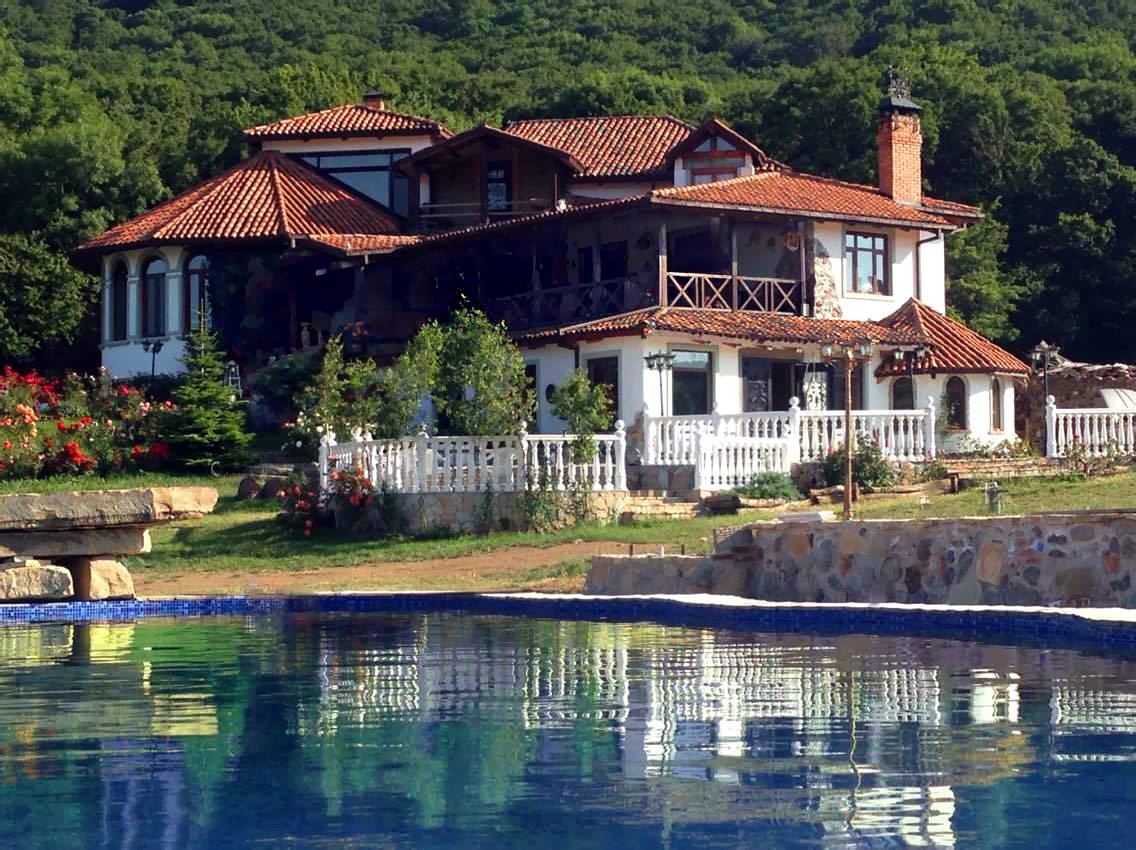
I share this lovely photo from Georgio's website. 


The Ranch was bustling with cars pulling in and people walking up to the big front porch. I wondered if the Ranch was a restaurant or maybe a resort, with its large estate, huge swimming pool and vast, panoramic views of the mountains.  Then I noticed the people were bringing food and greeting one another with hugs and kisses. This, we were told was Georgio and Marina's home. All these visitors were family members, some who had driven considerable distances, gathering at the Ranch, to meet us. It was a humbling realization. We were the guests of honor.


Lia, me, Maia, Katerina, Elene.
There were lots of introductions. Georgio and his wife, Marina, were the owners of the Ranch. Marina was a dentist by day, but also very talented with decorating and making the Ranch her project for the past twenty years. We toured the spacious home and beautiful grounds. It was a wedding venue, and a bed and breakfast. Georgio, who spoke English, invited us back to stay there when we brought the whole family next time.


Zaur giving me Roses

I was glad to learn that Zaur (rhymes with cow) or Zauri, as his cousins endearingly called him, would be there with his wife. Zaur begun messaging me in English early in 2015, shortly after we found the family. Over messenger, he shared family photos and gratitude that we had given his cousin's son a good life. I was excited to meet him in person. I recognized him as he climbed the steps to the porch with a  dozen red roses. My tears, always close to the surface, spilled over as he offered me the roses and big hug.  I excitedly started chatting with him. He held his hand up to stop me. "Sorry Debbie, only leetle English," he said apologetically.  I guess he had always translated his messages before sending them to me. Kind Zaur had sent me birthday, happy Fourth of July, Happy Election day--God Bless America, and Merry Christmas greetings through the year.


The young cousins. Roma would have been sitting with them. 


I had wondered if anyone would resent us for taking their cousin Igor's son. No one there that evening had ever met Roma, but this family who gathered to greet us this beautiful Sunday evening in June, was well acquainted and dearly loved Roma's father.


A few cousins, as we were introduced, apologized for not knowing the trouble Igor's family was facing across the northern border in Russia in the early years of the new millennium. Before social media and cell phones, families didn't have instant access to one another. Igor's father, Romani, was the only family member to leave Georgia to go to Russia in search of a job. It seemed to have been the undoing of a close-knit Georgian family. When Lia learned the children had been taken to an orphanage, she tried to help from Georgia, offering a home for Roma and Liana, his older sister, who we would meet later in the week when she arrived from Russia. Lia was flatly denied access to her own family members, even though she had the desire and the means to help them. To complicate matters, Georgians were not permitted to cross the Russian border. While still attempting to find a way to help, Roma was suddenly gone, as our adoption seemed to have been fast tracked for reasons we didn't know.

Of course we knew nothing of this extended family. And they knew nothing of us. Would anyone resent us, as Americans, a country who represented THE enemy throughout the Soviet years, who had taken their cousin's son away, just as family members were attempting to save him. The reversal of that scenario  I can almost imagine: What if a former Soviet had come and adopted a family member away from us who we were desperately trying to save. It scares me to think of what negative feelings I might harbor.

Lia's mother, me, Zauri, Bruce, Zaur's mother
But this close, big-hearted, and generous family, who so obviously shared my son's precious DNA, didn't resent that we were the reason Roma vanished in 2002. They approached us with warm hugs and kisses. The two sisters of Romani, Roma's late paternal grandfather, now in their eighties, repeated "Спасибо," Spah-see-boh, over and over, "Thank you"  

Any trepidation I might have had instantly melted away in the presence of their warmth. When they weren't close enough to hug and kiss us, they were sitting across the table during dinner, blowing us kisses, with the sweetest eyes of gratitude I have ever seen.

Cousins offered toasts again and again from pitchers brimming of homemade red wine all around the table covered with a feast of fresh fruit and vegetables and traditional Georgian food. They toasted, thanking God. They toasted us as wonderful parents. To the health and happiness of our other children. I lifted my glass to my dear sister Lia, for all she had done to organize our trip. Bruce thanked everyone for their generosity, as Maia translated. And in perfect English, Zauri, speaker of "leetle English" said, "To Debbie, the best Mother in the world." Between toasts, I told them our friends told us to find out where Roma got his big heart, wit, and personality. The cousins pointed to Zauri's mother, as she blew kisses, and smiled a revealing glimpse of mischief.

My heart was so full. So was my stomach.


After dinner, while Georgio was fetching his guitar, and the family was gathering in a large room, Zaur, who knew only "leetle English" began to sing in perfect English, the Beatles' "Girl."  "Is there anybody going to listen to my story all about a girl who came to stay? She's the kind of girl you want so much it makes you sorry. Still, you don't regret a single day," and then the rest of us chimed in, "Ah, girl. . . girl." That got the singing and dancing started in earnest.

I watched this close family.  Their interactions. Their boldness and wit and generosity, and vitality, trademarks that were also hardwired into the little Sudszashvili cousin I had the privilege to raise. The body movements, the arms slung around buddies. The confidence. The love of fun and family. I am confident Roma would have fit right in and competed for attention.


Our new family. How I love and miss them.

I may regret till my dying day that I did not find this dear, loving, generous family earlier, to ease their distress about the safety and well-being of Igor's "disappeared son." Roma was one of their own. But finding his lost family was an extremely emotional experience for Roma, even at age twenty-one. Would he have been ready to dig up old wounds from early childhood  prematurely? I'll never know. But this connection now, this evening in June, eighteen months after Roma left on his own adventure, laughing, crying, showing Roma's pictures, telling Roma stories, singing and dancing with Roma's blood relatives, God used to heal us all.

Over the past eighteen months I'm always talking to Roma. "Roma, are you here?" I will ask. And I can always almost hear him say, "Yeah, Mom, I'm right here."  

"Did you see all this tonight, Roma? You have a great first family. What a privilege to meet them.  Actually, your second family isn't so bad either! Aren't we blessed?"

Maybe knowing God has Roma, safe and sealed, helps me not be so devastated by his crushing absence. Losing Roma would be too much. But in fact, I haven't lost Roma at all. Loving his first family helps me understand that Roma will always go on in a Cosmic complexity about which I only have a hint. But I will gladly and thankfully take it. 

Thank you, God for this gift.


See some actions videos and more photos below. 


And Roma, who shared this DNA, would have been dancing too.


That's a BIG pool. Notice the rocks behind me. They can be clinbed to jump from. 

So thankful to be on this happy, yet perilous journey of life with Bruce. 
                                 
Continue here, Day Two.


                    *        *        *        *        *

Dont miss the exciting and heart breaking stories about finding this lovely family. Begin with Hope for Restoration. 

Many Roma and God Stories begin with The Hound of Heaven Winks. 

Writing through my grief begins here with The Agony. But don't stop there, or you'll miss the miracles! 

Readers can start at the beginning of our story by reading But the Greatest of These is Love.

Be blessed. Even in the pain, I feel like I have lived something Sacred. 


Saturday, July 15, 2017

Uplistsikhe, Day One, Tour Three


Part Six, STILL June 4th.

Start with Part One here.


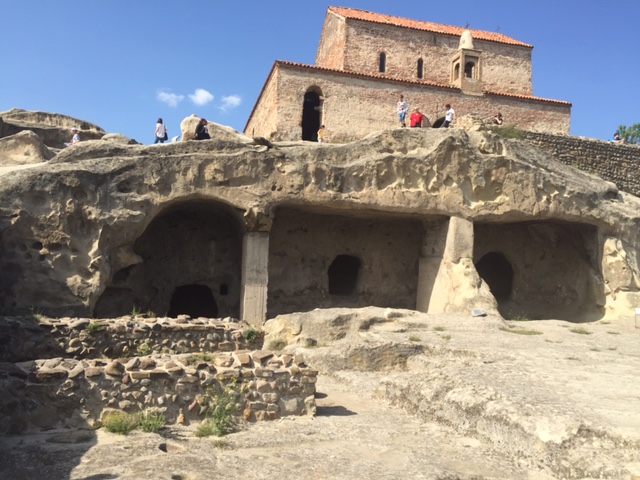
After lunch we headed to Uplistsikhe, about an hour's drive from Mtskheta.  Identified by archeologists as one of the oldest urban settlements in Georgia, Uplistsikhe literally means "the Lord's Fortress. " It dates back to the early Iron Age (1200- 600 B.C.), and older by some archeologists' estimates, and to the Bronze Age (3000- 2400 B.C.). Some later structures were added during the Middle Ages, or Medieval period, a thousand years from 500 A.D.-1500 A.D, which began with the fall of the Roman Empire until the rise of the Ottoman Empire.


It was an important religious,  political, and cultural center. Situated above the Mtkvari  River, the city stood directly on the path of the old Silk Road and was a strategic and commercial center.  The Silk Road was used regularly from 130 B.C. when trade from China was officially opened to the west, to 1453 A.D. when the Ottoman Empire boycotted trade with the west and closed the routes.


The town was in its heyday as early as the 9th- 11th century. It had a population of 20,000.


When Christianity came to Georgia in the fourth century A.D. in Mtskheta, and later Tbilisi, Uplistsikhe declined in importance. However, Uplistsikhe remerged as a principle Georgian stronghold during the Muslim conquest of Tbilisi in the eighth and ninth centuries. The Mongols raids in the 13th century marked the ultimate collapse of the town, and it was virtually abandoned except for an occasional temporary shelter in times of foreign invasions. The Mongols invaded Georgia in 1220 and again in 1231. At that time the Kingdom of Iberia included present day Georgia, Armenia, and much of the Caucus countries, including all or parts of Azerbaijan, Iran, Russia, and Turkey.

From the internet


Georgia fell under the domination of the Ottoman Empire in the 15th century. During the 18th and 19th century, it transitioned from being a mainly Iranian centered country to a Russian annexation.

Several of the most vulnerable areas were completely destroyed by an earthquake in 1920. The stability of the monument remains tenuous.

From the internet
From the internet


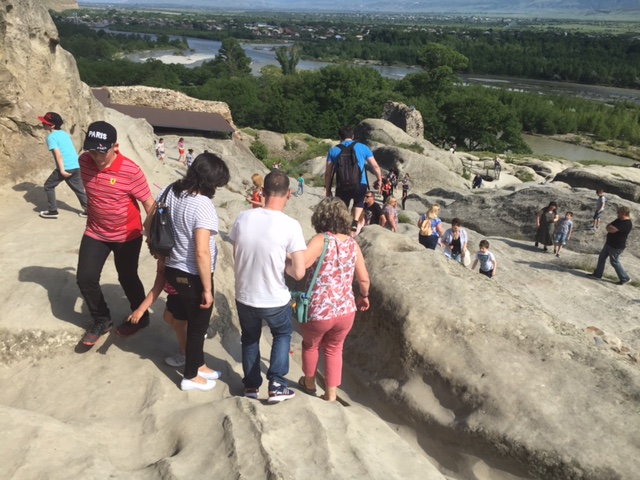
The living quarters and areas for communal purposes occupy a cliff of almost 2o acres. They are connected by steps carved into the stone. The majority of the caves are devoid of decoration. There is a large central meeting hall has coffered tunnel-vaulted ceiling and a palace complex. The natural sandstone made it easy to create carvings of intricate patterns. 
From the internet

There is a basilica from the 6th century, and a three-church basilica built out of brick in the 9th and 10th centuries. Later churches were added during the medieval period.

When we visited the National Museum in Tbilisi, we saw many of the ancient artifacts discovered from the archeological excavations, such as gold, silver, bronze jewelry, and ceramics and sculptures.


In ancient times, there were up to 700 caves, but today, only 150 have endured. 


This head-hurting map illlustrates the emormity and complexity of the site, 

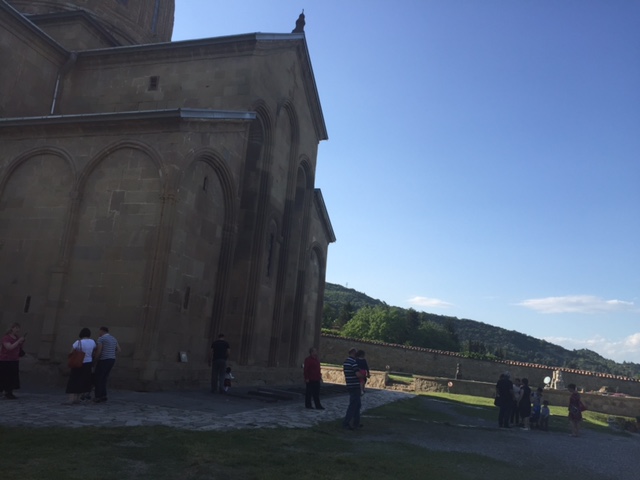
After leaving Uplistsikhe, we stopped briefly at another church. I am sorry I can't remember the name.  (Those names were pretty tricky!) We drank "holy water" from a spring, and I didn't even fear I might get sick. I felt protected and inviceable.  


We are still on day one! It was hard to believe we had gotten off the plane in Tbilisi on this same date, just after midnight. 

Next stop, a more personal story, dinner with Roma's family.  

Continue with Part Seven.


Tuesday, July 11, 2017

Svetitskhoveli, Day one, second tour

Part five. More history that was new and fascinating to me. I hope you learn something too.

(Start with Part One) 

(Part four)


After our morning visit to the Church of the Cross, we drove to the Svetitskhoveli Cathedral, another UNESCO site in Mtskheta. Because of many churches, religious relics, and the visitors who come on pilgrimages, the ancient capital of Georgia is called "the Second Jerusalem."


Svetitskhoveli was the largest church building in all of Georgia, until Holy Trinity Cathedral's construction 
between 1995 and 2004 in Tbilisi after the fall of Communism, (We visited that impressive church on our last night. Stay tuned.) The present church was completed in 1029, but the original church dates back to the early fourth century and the reign of King Mirian III, the first Christian king of Iberia, converted by Saint Nino. Read about Saint Nino in my last post. 


This Cathedral is best known as the burial site of Christ's Robe. The story goes that a Mtskheta Jew, Elias, was in Jerusalem when Jesus was crucified. He bought the robe from a Roman soldier at Golgotha and brought it back to his native city.

According to the Gospel of John, the soldiers who crucified Jesus did not divide his tunic after his death, but cast lots to determine who would own it. It was unusual, woven in one piece, without seam. A distinction is made in the New Testament Greek between the himatia (literally "over-garments") and the seamless robe, which is chiton (literally "tunic" or "coat.") The Septuagint version of Psalms 21: 18-19 reads,
"Then the soldiers when they had crucified Jesus, took his garments (ta himatia) and divided them into four parts, to very soldier a part, and the coat (kai ton chitona). Now the coat was without  seam, woven from the top down. Therefore, they said among themselves, let us not tear it, but cast lots for it, whose it will become. Thus the saying in Scripture was fulfilled: they divided My raiment (ta imatia) among them, and upon My vesture (epi ton himatismon) did they cast lots."


Tomb of Sidonia and the Holy Robe
Upon Elias's return to Georgia with the Sacred Robe, his sister, Sidonia, clutched the robe so tightly, she died of joy. The robe could not be pried from her firm grasp, and fearing damage to the precious garment, it was buried with her. Her tomb is preserved in the Svetitskhoveli Cathedral.


From Sidonia's grave grew an enormous cedar tree. Saint Nino came to Georgia three hundred years later, to venerate the Lord's robe. She had the tree cut down to build the first church. She had seven columns  made for the building. The seventh beam had magical powers, and lifted itself into the air. It returned to earth after St. Nino prayed through the night. Only that seventh column oozed a sap that had healing properties. Many people were cured from all diseases. The site because a destination for pilgrimages beginning in the Middle Ages to the present. Because the pilgrims would cut parts of the wooden column to take with them, long ago a stone enclosure was built encircling the holy column. Archeological testing in recent years confirmed the wooden beam in place inside the stone structure built for its protection.

The painting at the right is The Glory of Iberia (1880s). by Mikhail Sabinini, illustrating the legend of the Living Pillar. Saint Nino is standing to the right, with King Mirian III and Queen Nana kneeling on each side. The background is filled with the countless pilgrims to the Holy site. 

In Georgian, sveti  means "pillar," and tskhoveli means "life-giving" or "living" so the 

name Svetitskhoveli literally means "Cathedral of the Living Pillar." 

Christ's Seamless Tunic remained in Georgia until the seventeenth century, when the Persian Shah Abbas I invaded Georgia and stole the Robe. In order to gain favor with Tsar Mikhail Feodorovich, the Shah sent the Robe as a gift to Patriarch Philaret (1619-1633) and to Tsar Mikhail in 1625. The authority of the Robe was attested by Nectarius, Archbishop of Vologda, by Patriarch Theophanes of Jerusalem, and by Joannicius the Greek. Reports also circulated at that time of the miraculous signs being worked through the Holy garment.


Two portions Robe were taken to Saint Petersburg in 1625, one to the Winter's Palace, and the second, to Saints Peter and Paul Cathedral. Moscow also houses a portion of the garment at the Cathedral of the Dormition. There are small portions at other old temples.

The Russian Orthodox Church commemorates the Placing of the Honorable Robe of the Lord at Moscow on July 10 annually, since it was first placed there on the Sunday of the Cross, during Lent of 1625.

Svetitskhoveli has survived many adversaries over its long history, notably, invasions from Arabs, Persians, and Timor. Many priceless frescoes were destroyed during the Soviet era, by being whitewashed. Also, earthquakes have damaged the ancient structure originally constructed in the fourth century, with additions in the eleventh century.  

I'll pause right here and thank Wikipedia and many other internet sources and blogs too numerous to recall, as well as our capable and fast speaking tour guide at the Cathedral. I didn't have time to take notes on site, so I'm relying mostly on the internet for the information provided in these posts.


We went on a Sunday. The grounds inside the walls of the complex are a busling little community, with vendors sellling traditional Georgian wares, such  felted toys and shoes, and Churchkhela candy, which at first glance, I couldn't tell if they were candles or sausage hanging from strings over bars.  We dined inside the complex, tasting our first Khinkali (meat dumplings)  and Khachapuri (cheese pie). 

Then we were off to Uplistsikhe. Still day one! 


See more photos here. 

My trip last month, June 2-12, I went as a visitor and observer of interesting, holy, and majestic sites. My next trip I will return a pilgrim.


                                     *        *        *        *        *        *


Readers can start at the beginning of our story by reading But the Greatest of These is Love.

Blog post series while finding Roma's family members begin with Hope for Restoration. 

Many Roma and God Stories begin with The Hound of Heaven Winks. 

Writing through my grief begins here with The Agony. But don't stop there, or you'll miss the miracles! 


Be blessed. Even in the pain, I feel like I have lived something Sacred.